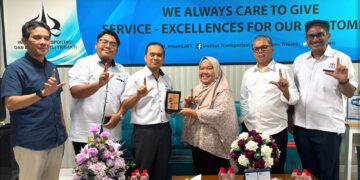



Universiti Kuala Lumpur (UniKL) is expanding its international research footprint through a Malaysia–Indonesia collaboration exploring how everyday wireless signals could be converted into usable electrical energy.
From 3 to 7 August 2026, researchers from UniKL British Malaysian Institute (UniKL BMI) worked with Universitas Pakuan (UNPAK), Bogor, and Indonesia’s National Research and Innovation Agency (BRIN) under the UniKL Global Research Mobility Incentive 2026.
The programme was led by Ts. Dr. Faezah Harun, accompanied by Ir. Ts. Dr. Noor Hidayah Mohd Yunus.
At the centre of the collaboration is the development of a spiral resonator-based multiband rectenna for radio frequency (RF) energy harvesting in 5G environments.

The research investigates how ambient electromagnetic energy from wireless communication sources can be captured and converted into direct-current electrical energy.
The proposed system is designed to operate across a broad frequency range of approximately 100 MHz to 6 GHz, opening possibilities for harvesting low-level RF energy generated by sources such as cellular networks, Wi-Fi and other wireless communication systems.
Rather than relying on a single area of expertise, the project combines the research strengths of all three institutions.
UniKL and UNPAK are contributing to antenna design, simulation, optimisation and performance evaluation, while BRIN brings expertise in rectifier development and RF-to-DC power conversion.
During the mobility programme, the researchers conducted technical discussions, research meetings and knowledge-sharing sessions to refine the project methodology, system integration approach and potential experimental validation.
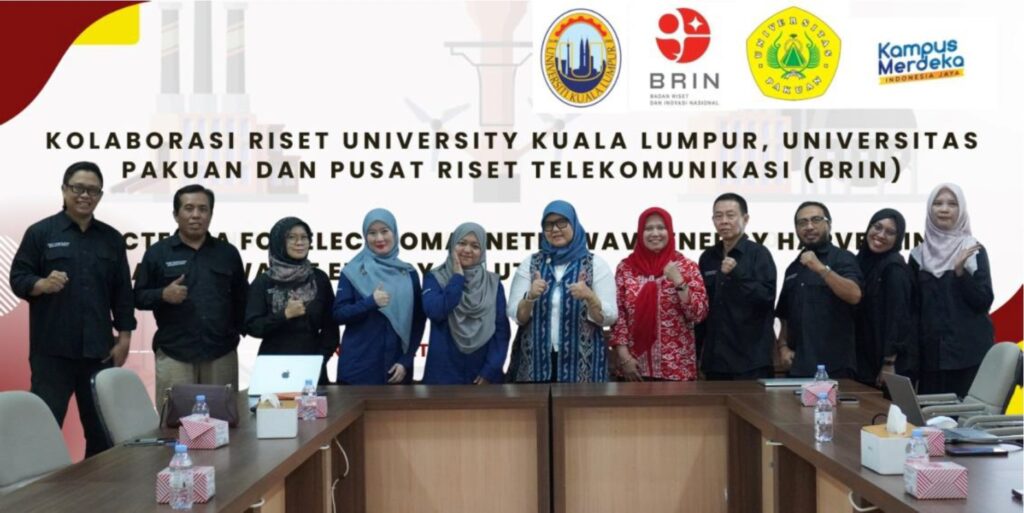
The team also explored future opportunities involving joint publications, student participation and further experimental work.
Laboratory visits to facilities at UNPAK as well as BRIN’s electronics and telecommunications research centres further exposed the UniKL team to ongoing developments in electrical engineering, electronics and telecommunications research.
A key outcome of the programme was the identification of strong similarities and complementary expertise in antenna research between UniKL and UNPAK.
The collaboration also opened possibilities to integrate Internet of Things (IoT) applications with antenna, sensing, wireless communication and energy-harvesting research.
The partnership is expected to progress beyond research discussions towards rectenna fabrication, characterisation, experimental testing and performance validation.
For UniKL, the collaboration strengthens its global research network in 5G technology, RF energy harvesting, wireless communication, semiconductor devices, IoT and sustainable electronics — areas increasingly relevant to the development of energy-efficient connected technologies.
The initiative also strengthens international academic cooperation between Malaysia and Indonesia while providing a platform for research that may ultimately translate into practical technological applications.
From a global impact perspective, the research supports the United Nations Sustainable Development Goals (SDGs), particularly SDG 7: Affordable and Clean Energy through exploration of alternative energy-harvesting technologies; SDG 9: Industry, Innovation and Infrastructure through research in 5G, wireless technology and advanced electronics; and SDG 17: Partnerships for the Goals through cross-border university and national research collaboration.