


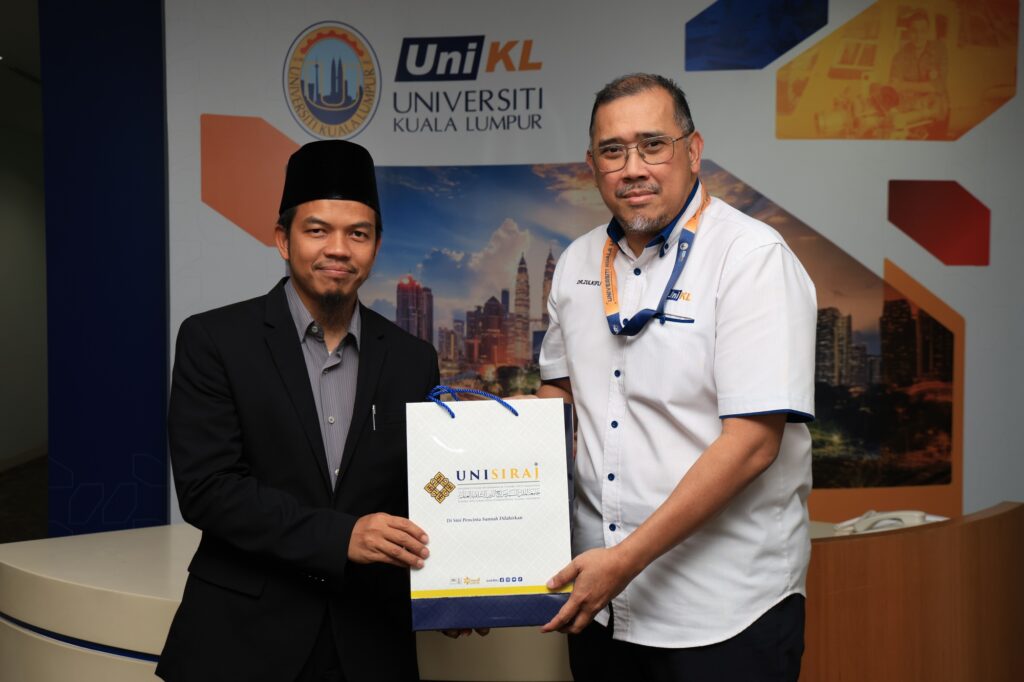
Universiti Kuala Lumpur (UniKL) shared its approaches to academic governance, quality assurance and internationalisation with Universiti Islam Antarabangsa Tuanku Syed Sirajuddin (UniSIRAJ) during a benchmarking engagement on 22 September 2026.
UniKL was represented by its Covering Deputy Vice-Chancellor, Academic and Internationalisation, Ts. Dr. Zulkifli Mahmoodin, together with representatives from Centre for Innovative Digital Education and Emerging Technology (CIDEX), Centre for Quality Assurance (CQA), the Academic and Management Division (ACMD) and Marketing, Student Recruitment, and Admission (MeSRA).
The UniSIRAJ delegation comprised Director of the Department of Academic Affairs Syarifah Fairuz Syed Radzuan; Head of Academic Development Division Mohd Zaki Ab Rahman; Head of Academic Management Division Naurul Idayu Kamardin; Administrative Officer of the Curriculum, Learning and Teaching Section Imtinan Abd Karim; and Administrative Officer of the Analytics and Strategic Marketing Section Siti Haslinda Muhamad.
The engagement centred on how university-level academic structures can support effective programme governance, curriculum management, assessment processes, accreditation and continuous quality improvement.
UniKL shared the governance structure underpinning its academic operations, including the roles of ACMD and CQA in overseeing academic management and programme quality.
The exchange also allowed UniKL to share its wider identity as an industry-driven technical university, where specialised campuses, professional certifications and close industry engagement complement classroom learning.
Among the approaches highlighted was the teaching factory concept, which brings industry activities closer to the university environment, enabling students to gain exposure to real operational settings while creating opportunities for research and industry collaboration.
For UniSIRAJ, the benchmarking engagement provided an opportunity to examine structures and processes that may inform its continuing institutional development following its transition from Kolej Universiti Islam Perlis (KUIPs) to university status.
Beyond the exchange of processes and organisational structures, the engagement reflects the role of inter-university collaboration in strengthening higher education quality, institutional capability and knowledge sharing.
The engagement also supports the United Nations Sustainable Development Goal (SDG) 4: Quality Education, through the sharing of practices that strengthen academic quality and learning systems, and SDG 17: Partnerships for the Goals, by encouraging institutional cooperation and knowledge exchange between Malaysian universities.