

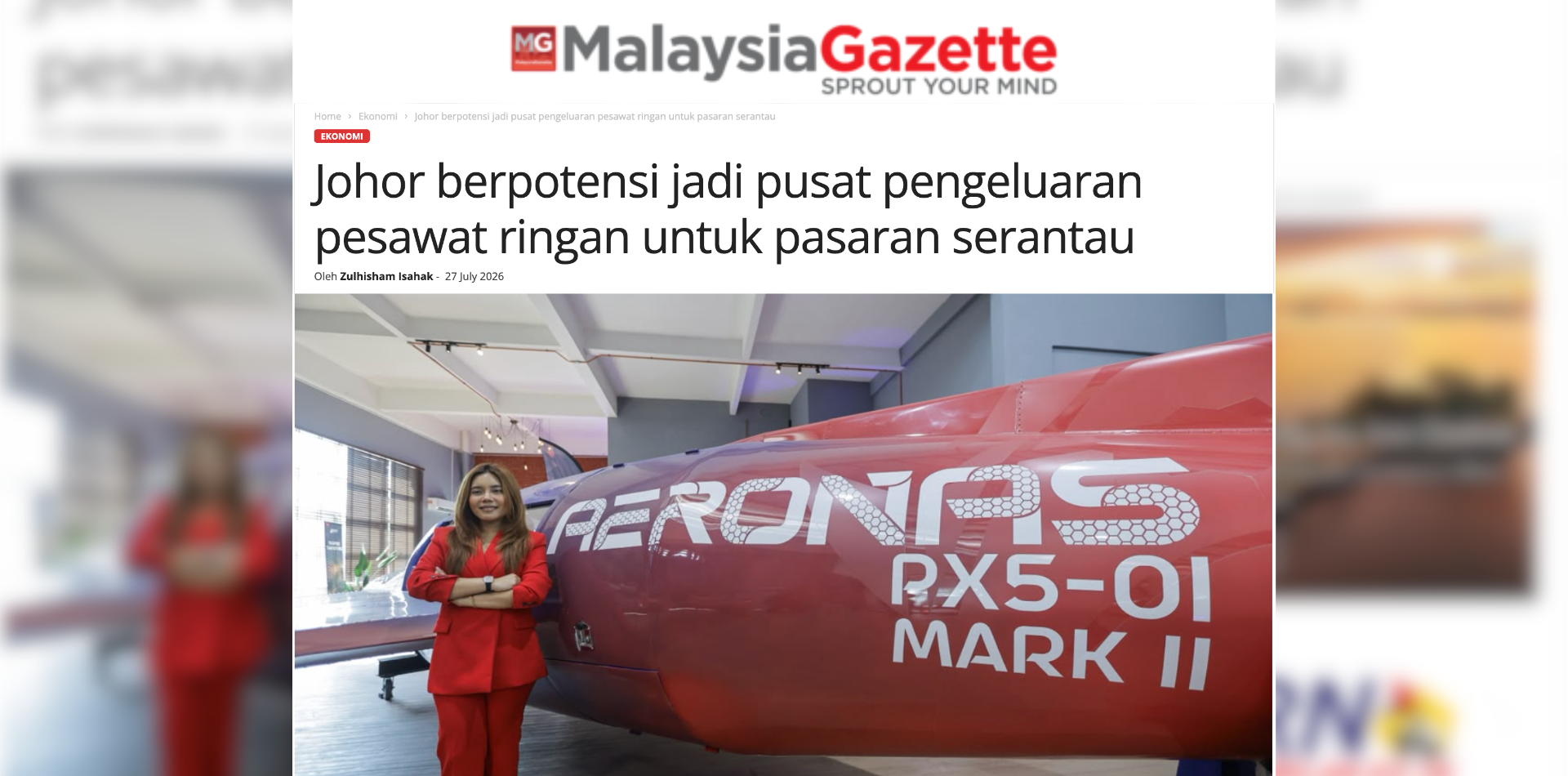
Aeronas Aerocraft Sdn Bhd is seeking to position Johor as a regional centre for light aircraft manufacturing and maintenance, repair and overhaul (MRO), potentially strengthening Malaysia’s role in the global aerospace industry.
The Bumiputera-owned company, recognised as Malaysia’s first light aircraft manufacturer, is expanding its operations in Johor to support aircraft production, aviation maintenance, engineering services and the development of a wider aerospace supply chain.
The initiative complements the Economic Development pillar of the Maju Johor 2030 agenda, which seeks to attract high-value investments and create more skilled, premium-paying employment opportunities in the state.
In July 2026, Aeronas Aerocraft Managing Director Raja Shazreen Petra Raja Azman Shah Petra said Johor offered the infrastructure, industrial ecosystem and strategic location required to become an important regional base for aircraft-related activities.
Aeronas currently operates manufacturing facilities in Senai and Iskandar Puteri and is developing an additional facility to expand its production capabilities.
Its existing semi-production facility can manufacture up to 30 aircraft annually. Once the proposed full-scale manufacturing facility is operational, production capacity is expected to increase to up to 60 aircraft per year per production line.
At present, approximately 78 percent of the aircraft manufacturing work is undertaken in Malaysia. Aeronas aims to increase local production content to 100 percent within the next three to five years.
Universiti Kuala Lumpur (UniKL) has been identified as one of Aeronas Aerocraft’s higher education partners supporting the development of Malaysia’s future aerospace workforce.
The collaboration covers areas such as talent development, industry-oriented training, research and technical capacity building to meet the growing requirements of aircraft manufacturing and the broader aviation ecosystem.
UniKL’s involvement is particularly significant through the Universiti Kuala Lumpur Malaysian Institute of Aviation Technology (UniKL MIAT), one of Malaysia’s established institutions specialising in aviation and aircraft maintenance education.
UniKL MIAT provides students with practical, industry-relevant learning through aviation laboratories, workshops and hangar-based training environments. This enables students to develop technical competencies using facilities that closely reflect actual aviation industry operations.
The UniKL MIAT campus in Subang is also equipped with taxiway infrastructure, strengthening its potential to become a comprehensive MRO education and training hub.
The infrastructure could support more advanced practical training, aircraft movement, maintenance simulation, technical certification programmes and collaborative activities involving aviation companies and regulatory bodies.
With the right industry partnerships and further development, UniKL MIAT could serve as an important educational extension of Malaysia’s aerospace and MRO ecosystem, complementing industrial developments in Johor and other aviation clusters across the country.
Aeronas Aerocraft expects the expanding aircraft industry to generate significant employment opportunities across Malaysia’s aerospace value chain.
More than 450 highly skilled positions have already been created directly, while approximately 3,000 additional jobs are expected to emerge within logistics, aviation support services and related industries.
When its production operations reach full capacity, the wider aerospace ecosystem could potentially create up to 20,000 employment opportunities.
These positions would provide engineering graduates and TVET-trained professionals with greater opportunities to build internationally relevant careers without having to leave Malaysia.
The collaboration contributes particularly to United Nations Sustainable Development Goal 4: Quality Education, through industry-relevant aviation education; SDG 8: Decent Work and Economic Growth, through skilled employment creation; and SDG 9: Industry, Innovation and Infrastructure, through aerospace manufacturing, MRO development and advanced technical infrastructure.
It also supports SDG 17: Partnerships for the Goals by bringing together universities, government agencies and industry partners to develop Malaysia’s aerospace workforce and innovation capacity.
Noted: This article was first published by Malaysia Gazette and has been adapted for UniKL Xpress.