


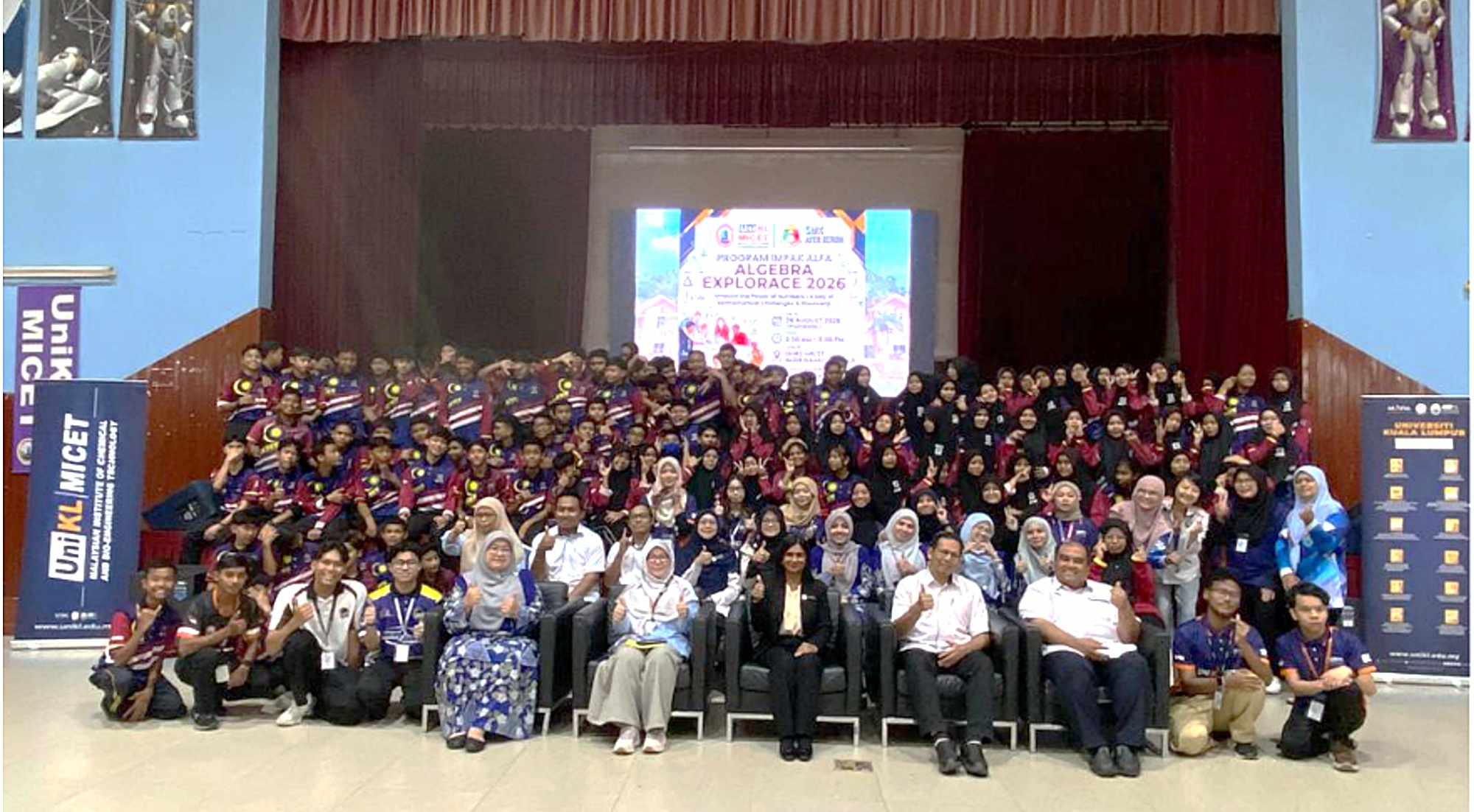
Algebra moved beyond textbooks and into a fast-paced learning experience at Universiti Kuala Lumpur Malaysian Institute of Chemical & Bioengineering Technology (UniKL MICET), where 125 secondary school students put their mathematical thinking to the test through puzzles, teamwork and hands-on challenges.
Held on 26 August 2026, the Program Impak Alfa: Algebra Explorace 2026 brought together UniKL MICET, Sekolah Menengah Kebangsaan (SMK) Ayer Keroh and the Melaka State Education Department (JPN Melaka) to introduce a more engaging approach to mathematics for students aged 13 and 14.
At an age when students begin moving from basic arithmetic and concrete mathematical concepts towards abstract algebraic reasoning, the programme was designed to make mathematics more relatable and less intimidating.
Rather than relying solely on conventional classroom instruction, Algebra Explorace incorporated game-based and kinesthetic learning, encouraging students to solve problems collaboratively while developing a more positive attitude towards mathematics.
The 125 participants were divided into 10 groups and challenged to complete seven mathematical puzzles across seven stations at UniKL MICET’s Lestari Hall.
Teams were assessed based on both accuracy and completion time, adding an element of excitement and friendly competition to the learning experience.
Three groups that completed all the challenges correctly in the shortest time emerged as winners, while the remaining participants received tokens of appreciation.
Beyond mathematics, the programme also gave the students an opportunity to experience a university environment and gain early exposure to science, technology and engineering education.
Accompanied by their teachers, the students toured several UniKL MICET laboratories, including the Pilot Plant, Food GMP Laboratory, Plastics Processing Laboratory and Wastewater Treatment Laboratory, offering them a closer look at how scientific and engineering knowledge is applied beyond the classroom.
The programme reflects UniKL’s wider commitment to STEM education, experiential learning, school engagement and community outreach, while strengthening university-school partnerships that can encourage greater interest in science and technology among younger learners.
The initiative contributes primarily to the United Nations Sustainable Development Goal (SDG) 4: Quality Education, particularly through inclusive and engaging learning opportunities, while its partnership with SMK Ayer Keroh and JPN Melaka also supports SDG 17: Partnerships for the Goals.


