

Universiti Kuala Lumpur (UniKL) is setting its sights on a new chapter of academic excellence, research impact and global recognition as it begins shaping UniKL Beyond 2030, a strategic direction aimed at strengthening the university’s position among leading higher education institutions in Asia.
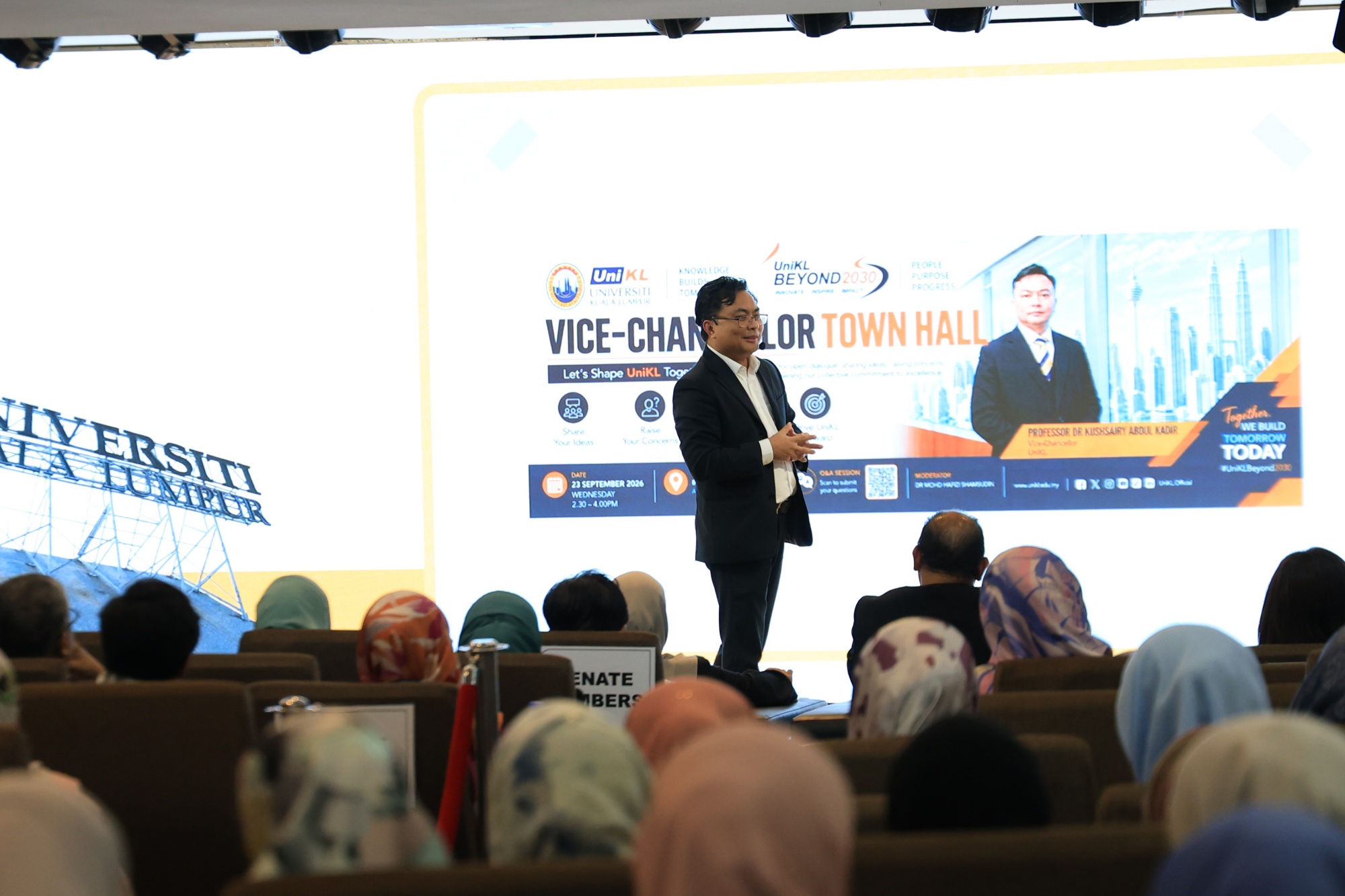
The direction was shared by UniKL Vice-Chancellor Prof. Dr. Kushsairy Abdul Kadir during a Town Hall Session with UniKL academicians on 23 September 2026, where he outlined the university’s ambition to work towards becoming a Top 200 university in Asia by 2030.
More than a rankings target, the aspiration represents an institution-wide push to strengthen academic quality, high-impact research, international collaboration, industry engagement, university reputation and the overall student experience.
Prof. Dr. Kushsairy said achieving the ambition would require UniKL to move forward as one university, with its academic community working towards a shared strategic direction.

Central to the proposed UniKL Beyond 2030 roadmap are strategic areas covering academic excellence, talent and culture, industry leadership, research and innovation, global engagement, and technology-enabled education.
Prof. Dr. Kushsairy also highlighted the importance of building UniKL’s reputation beyond Malaysia, noting that stronger global visibility is necessary to attract international students, researchers, collaborators and strategic partners.
International collaboration will therefore form an important part of the roadmap, with greater emphasis on research partnerships, international academic mobility, global conferences and networks that can connect UniKL researchers with their counterparts around the world.
“Grow international collaboration. Expand international students and faculty.
“The plan will not be enough. We need every one of us to put our effort and our brain into it,” he said.
The strategy will also build on UniKL’s distinctive position as a technical university closely connected to industry.

As a university rooted in Higher Technical and Vocational Education and Training (HTVET), UniKL aims to deepen university-industry collaboration while creating stronger pathways for research commercialisation, start-ups, spin-offs and technology-based entrepreneurship.
The Beyond 2030 direction is expected to be developed collaboratively rather than as a top-down plan.
By its later phases, UniKL aims to strengthen globally visible areas of excellence and establish a stronger international reputation for its academic, research, innovation and industry capabilities.
Also present at the session were Deputy Vice-Chancellor (Student Development and Campus Lifestyle) Prof. Ts. Dr. Zalizah Awang Long; Deputy Vice-Chancellor (Research and Enterprise) Prof. Ir. Dr. Azmi Hassan; and covering Deputy Vice-Chancellor (Academic and Internationalisation) Ts. Dr. Zulkifli Mahmoodin, alongside UniKL deans and academicians.
As UniKL approaches another important stage in its development, the Beyond 2030 ambition supports the United Nations Sustainable Development Goals (SDGs), particularly SDG 4: Quality Education through stronger teaching, learning and academic quality; SDG 8: Decent Work and Economic Growth through graduate development and entrepreneurship; SDG 9: Industry, Innovation and Infrastructure through research, technology and commercialisation; and SDG 17: Partnerships for the Goals through international and industry collaboration.