

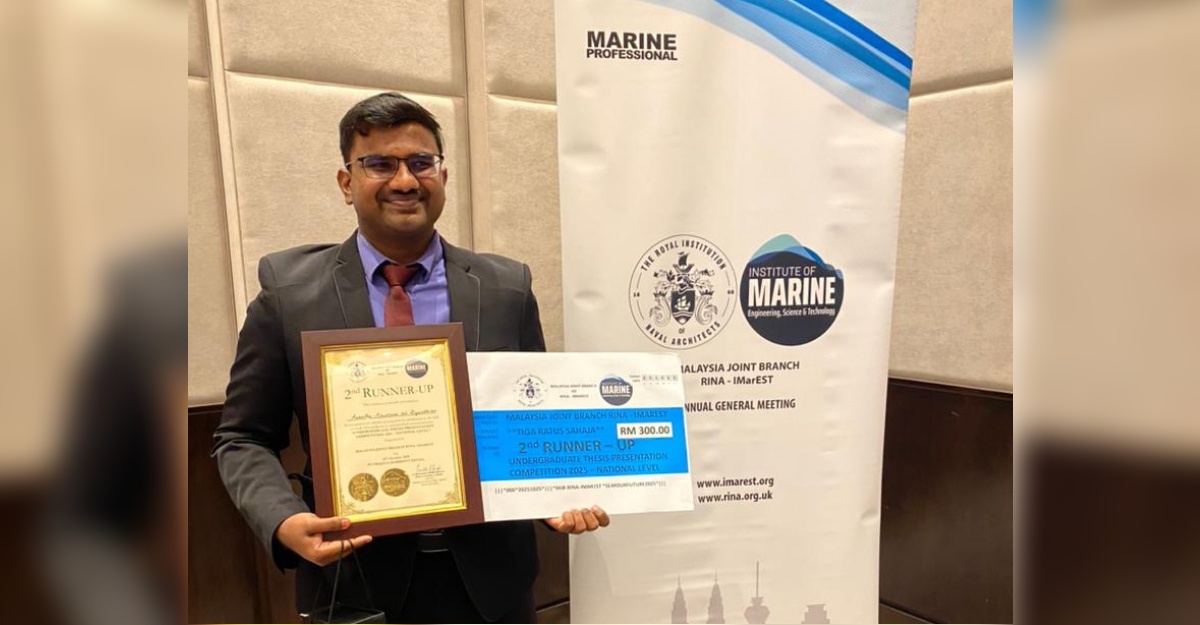
A research project on the reconceptualised Backward Bent Duct Buoy (BBDB), a unique form of Oscillating Water Column (OWC) wave energy converter, has earned Universiti Kuala Lumpur Malaysian Institute of Marine Engineering Technology (UniKL MIMET) a second runner-up award at a national innovation competition.
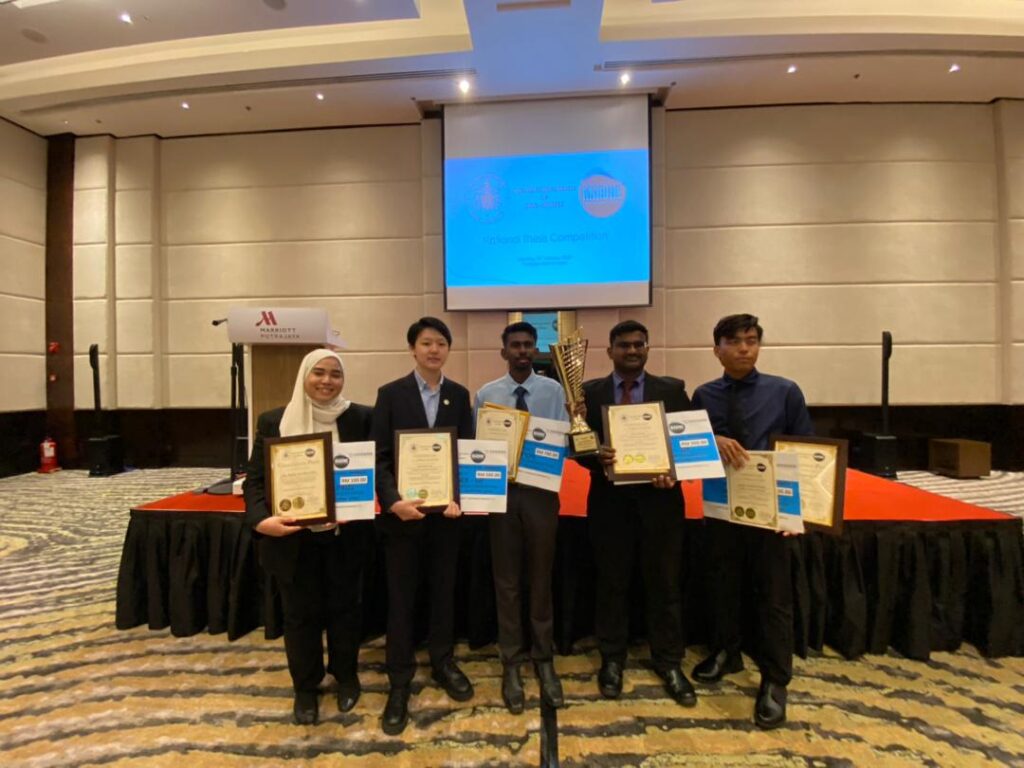
Developed by Anantha Krishnan A/L Rajendaran, a Bachelor of Engineering Technology (Hons.) in Naval Architecture and Shipbuilding student at UniKL MIMET, the project secured the award during the Undergraduate Thesis Presentation Competition (UGTPC) organised by MJB Rina IMarEST.
The event was held on 25 October at the Marriott Hotel, Putrajaya.
Unlike conventional OWC devices, Anantha explained that the BBDB features an opening mouth facing the opposite direction of the incoming wave, allowing waves to enter the duct and generate enhanced air compression within the chamber.
This backward-bent configuration amplifies pressure fluctuations, enabling more efficient conversion of low-frequency wave motion into pneumatic power to drive an air turbine and produce electricity.
While the original BBDB design was developed for moderate to high wave environments, such as Japan, Malaysia’s seas are characterised by low wave heights and longer wave periods.
Anantha’s research, therefore, focuses on adapting and optimising the BBDB for Malaysia’s low-energy wave conditions.
The innovation lies in tuning the BBDB’s hydrodynamic response through suitable mooring configurations, allowing it to resonate effectively with the country’s typical low-wave spectra.
Supervised by Mr. Nasuha, Dr. Adli, and Ts. Rohaizad, Anantha conducted an in-depth investigation comparing taut and catenary mooring systems.
This innovation contributes to Malaysia’s renewable energy agenda and aligns with the United Nations Sustainable Development Goal (SDG) No. 7: Affordable and Clean Energy.
The BBDB technology offers a clean, continuous, and predictable power source, potentially complementing solar and wind in hybrid coastal energy systems. It also opens opportunities for green technology commercialisation, rural electrification, and energy resilience for off-grid island communities.
Looking ahead, the research aims to advance from simulation and scale-model testing to prototype deployment in Malaysian waters through collaborations with academic and industrial partners.
Once validated, the optimised BBDB design with catenary mooring will be further developed for commercialisation, supporting Malaysia’s vision to become a hub for low-wave energy technology and sustainable innovation.