

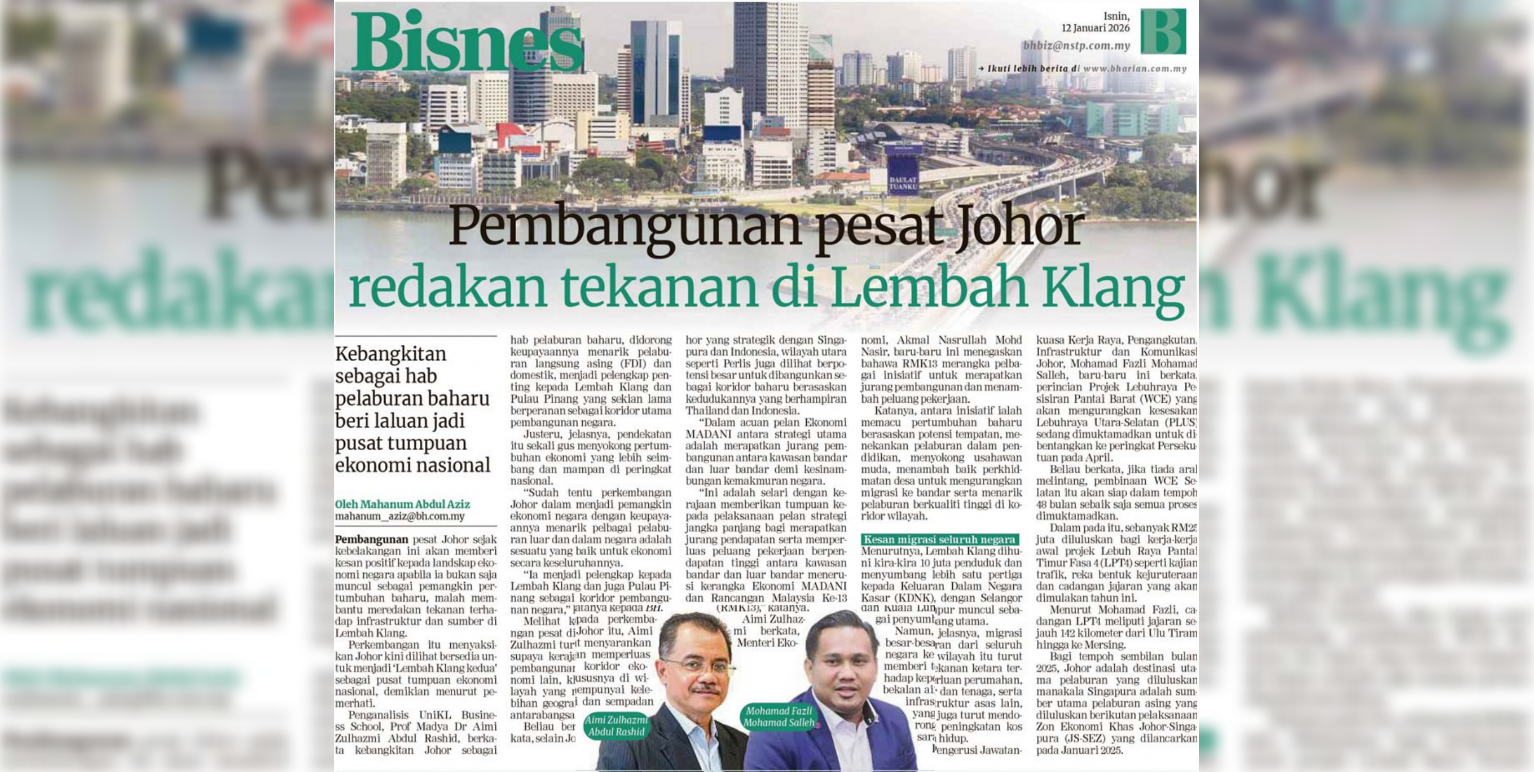
Johor’s rapid development in recent years is expected to have a positive impact on the national economic landscape, as it not only emerges as a new growth catalyst but also helps ease pressure on infrastructure and resources in the Klang Valley.
This development has led observers to view Johor as ready to become a “second Klang Valley,” serving as a new focal point of national economic activity.
Speaking exclusively to Berita Harian, Associate Professor Dr Aimi Zulhazmi Abdul Rashid from UniKL Business School (UniKL BIS) said Johor’s rise as a new investment hub, driven by its ability to attract both foreign direct investment (FDI) and domestic investment, serves as an important complement to the Klang Valley and Penang, which have long functioned as the country’s main development corridors.
“As Johor develops into a catalyst for the national economy through its capacity to attract both foreign and domestic investments, it is a positive development for the economy as a whole. It complements the Klang Valley and Penang as key national development corridors,” he told Berita Harian.
Dr Aimi Zulhazmi also suggested that the government should continue expanding other economic corridors, particularly in regions with geographical advantages and strong international connectivity.
“In addition to Johor’s strategic location near Singapore and Indonesia, northern states such as Perlis also have significant potential to be developed as new economic corridors due to their proximity to Thailand and Indonesia,” he said.
“Under the MADANI Economy framework, one of the key strategies is to narrow the development gap between urban and rural areas to ensure the sustainability of national prosperity.
“This aligns with the government’s focus on implementing long-term strategic plans to reduce income disparities and expand high-income employment opportunities across urban and rural areas through the MADANI Economy framework and the 13th Malaysia Plan (RMK13),” he added.
Recently, Deputy Minister of Economy Datuk Seri Akmal Nasrullah Mohd Nasir emphasised that RMK13 outlines various initiatives to narrow development gaps and increase employment opportunities.
These initiatives include driving new growth based on local potential, prioritising investment in education, supporting young entrepreneurs, improving rural services to reduce migration to urban areas, and attracting high-quality investments into regional corridors.
Note: This article was translated into English and originally published in Berita Harian on 12 January 2026. Associate Professor Dr Aimi Zulhazmi Abdul Rashid’s insights align with UniKL’s ongoing efforts to support Malaysia’s achievement of the United Nations Sustainable Development Goals (SDGs), particularly SDG 8: Decent Work and Economic Growth, SDG 10: Reduced Inequalities, and SDG 11: Sustainable Cities and Communities.