


As Malaysia accelerates its transformation into a high-income nation, the focus has shifted sharply towards building a future-proof workforce equipped for high-tech industries beyond IR4.0—such as drone technology, robotics, smart manufacturing, and AI-driven logistics.
With the global skills landscape evolving rapidly, the question of who will power this transition has never been more urgent.
In response to this national agenda, the Final Junior Skills Malaysia (JSM) – LIMA 2025 Edition, held during the prestigious Langkawi International Maritime and Aerospace Exhibition, set in motion an important early intervention effort by introducing school-level participants to the world of Technical and Vocational Education and Training (TVET).
This initiative reflects Malaysia’s growing recognition that talent development must begin earlier, and that TVET must be viewed not as an alternative, but as a primary path to high-value, future-ready careers.
According to Mr Mohd Zaki Mohamed, Director of UniKL WorldSkills & Teaching Factory Division, the event not only achieved its aim of raising awareness among students but also strengthened Malaysia’s collaborative framework between academia, government, and industry which is a critical triangle for the success of national skills development.

“This impactful competition was jointly organised by Jabatan Pembangunan Kemahiran (JPK), Universiti Kuala Lumpur Malaysian Institute of Aviation Technology (UniKL MIAT) and the UniKL WorldSkills Centre, with strong support from the LIMA 2025 organiser.
“Each competition module was designed in accordance with the WorldSkills Occupational Standards Specifications (WSOSS) and Technical Descriptions (TDs), ensuring alignment with international benchmarks,” said Mr Mohd Zaki, who also serves as the Deputy Dean of UniKL Malaysia France Institute (UniKL MFI), for the International, Industrial, and Institutional Partnership (IIIP) sector.
Focusing on the emerging field of drone technology, the competition featured 18 junior competitors from various schools and institutions nationwide.
They were tested across three rigorous modules — Manual Piloting, Autonomous Mission, and Mission Operation — reflecting the complexity and multi-disciplinary nature of real-world drone applications.
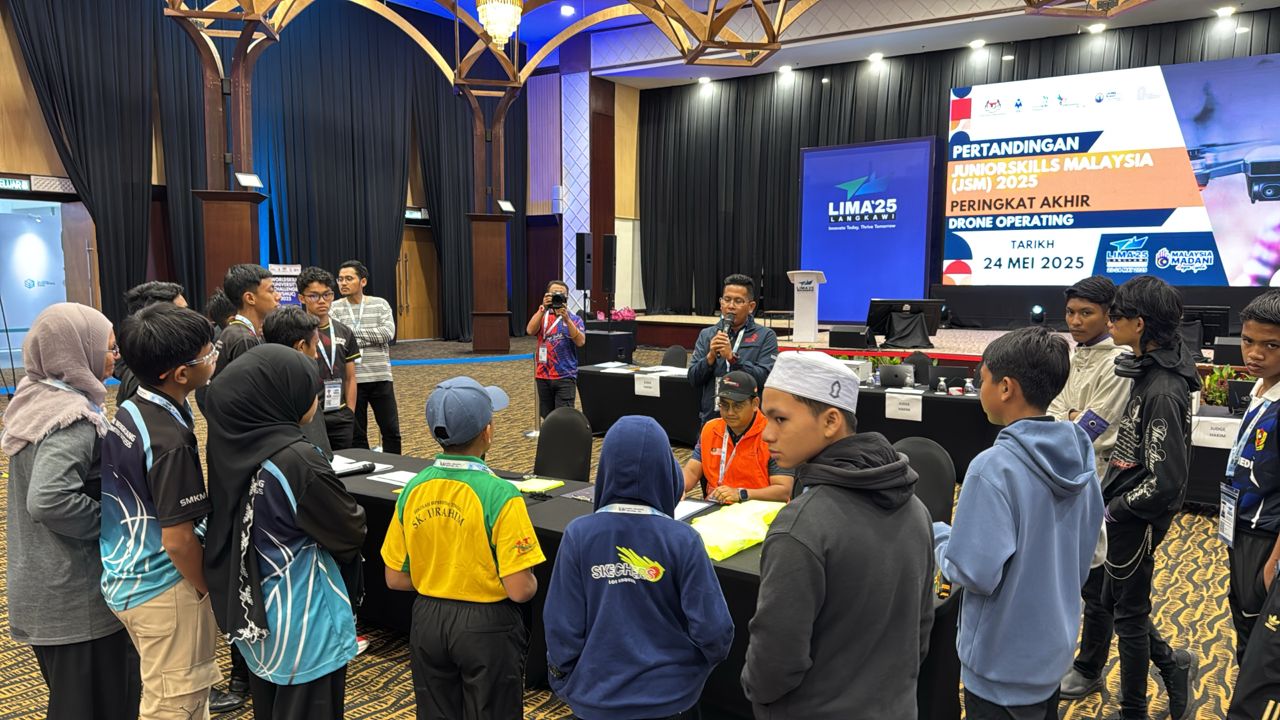
Following a competitive selection process, eight teams advanced to the final round, representing Kolej PERMATA@Pintar Negara (2 teams); GiatMARA Pasir Gudang; Sekolah Kebangsaan Ibrahim; Sekolah Menengah Kebangsaan Mengkuang; Sekolah Menengah Tuanku Jaafar; SBP Integrasi Kuantan; and Sekolah Menengah Pengkalan Chepa.
By immersing students in industry-aligned technical modules at an early stage, the JSM-LIMA 2025 initiative mirrors the country’s broader goal of creating a pipeline of skilled, innovative, and globally competitive talent.
As Malaysia continues to promote TVET through policies like the National TVET Council framework, MyFutureJobs, and the Madani Economy blueprint, events like JSM-LIMA 2025 illustrate how early engagement, industry-led curriculum, and international standards can converge to redefine the nation’s education and talent strategies.